













The Evolution of Semantic Web: From Microdata to JSON-LD
For over two decades, search engines struggled to interpret the contextual meaning of raw HTML documents. Early web crawlers relied almost exclusively on keyword frequency, title tags, and backlink topology to infer topical relevance—an approach easily manipulated by keyword stuffing and cloaking techniques.
To bridge the semantic divide between human-readable presentation and machine-actionable data, the W3C and leading search engines introduced structured data syntaxes. The first widespread iterations were Microformats, followed by HTML5 Microdata and RDFa (Resource Description Framework in Attributes). While revolutionary, these earlier standards suffered from a fatal architectural flaw: they were tightly coupled to the HTML Document Object Model (DOM).
Under Microdata, developers were forced to inject attributes like itemscope, itemtype, and itemprop directly into presentation tags (div, span, p). Whenever a frontend engineer redesigned a page, altered CSS class hierarchies, or refactored React components, the nested semantic hierarchy frequently broke, producing silent validation failures in Google Search Console.
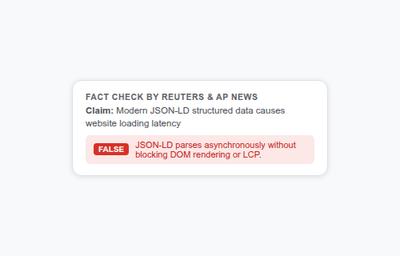
In 2015, Google fundamentally reshaped the semantic landscape by officially declaring JSON-LD (JavaScript Object Notation for Linked Data) as its preferred structured data format. Standardized under W3C RFC 8259, JSON-LD encapsulates structured entities within an isolated script tag of type application/ld+json. This architectural decoupling represents the single most important advancement in modern technical SEO: semantic metadata can now be dynamically generated, serialized on the server, and tested independently of HTML visual templates.
By isolating structured data into dedicated JSON-LD blocks, web platforms eliminate UI regression risks. Frontend design updates and component refactoring can proceed without threatening your rich snippet eligibility or Google Search Console indexing pipelines.